Fake Profiles and Scam Prevention: How Modern Staffing Platforms Protect Both Sides of the Hire
Fraudulent candidate profiles and fake recruiter scams cost companies and job seekers time, money, and trust. Here is how technology-driven staffing platforms detect and stop them before damage is done.
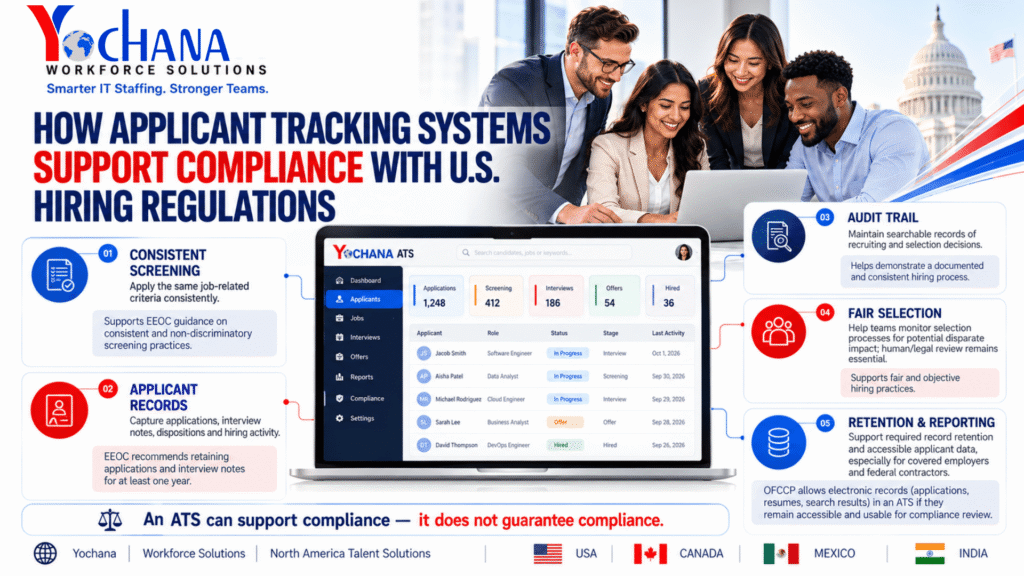
The hiring pipeline has become a target on both ends. Employers face candidates who fabricate credentials, run interview proxies, or use AI-generated resumes and deepfake video calls to pass screening. Job seekers, meanwhile, are targeted by fake recruiters running phishing schemes, fraudulent job postings, and upfront-payment scams that impersonate real staffing firms. As hiring moves faster and further online, the platforms and processes standing between both sides need to work harder to verify who is real.
Two Sides of the Same Problem
Fake profile and scam risk does not look the same from a hiring manager's chair as it does from a job seeker's inbox. Toggle between the two views below to see how the threat, and the defense, differs.
What you are up against
- Fabricated credentials: degrees, certifications, and employment dates that do not survive a verification check.
- Interview proxies: a more qualified stand-in interviews on video or phone, while a different, less-qualified person shows up to work.
- AI-polished resumes: generic, keyword-stuffed resumes generated to beat applicant tracking systems, disconnected from real experience.
- Duplicate or recycled identities: the same candidate applying under multiple names or slightly altered profiles to bypass a rejection.
What to look for
- Inconsistent details between a resume, a LinkedIn profile, and live interview answers.
- Reluctance to turn on video, or video quality/lighting that looks inconsistent with a stated location.
- Vague answers to specific, role-based technical questions that a resume claims fluency in.
- References that are unreachable, or that answer suspiciously fast with generic praise.
What you are up against
- Fake recruiter outreach: messages impersonating real staffing firms or recruiters, often copying real employee names and photos.
- Upfront payment scams: requests for money for "training materials," background checks, or equipment before any real offer exists.
- Ghost job postings: listings for roles that do not exist, used to harvest resumes, personal data, or contact information.
- Fake offer letters: professional-looking documents sent to pressure quick acceptance and personal data (SSN, bank details) before verification.
What to look for
- A recruiter contacting you from a free email domain instead of a verified company domain.
- Any request for payment, gift cards, or banking details before a formal, signed offer.
- Job offers with no interview, or an interview conducted entirely over text-based chat.
- Pressure to decide "within hours" or share sensitive personal data immediately.
The Technology Stack Behind Scam Prevention
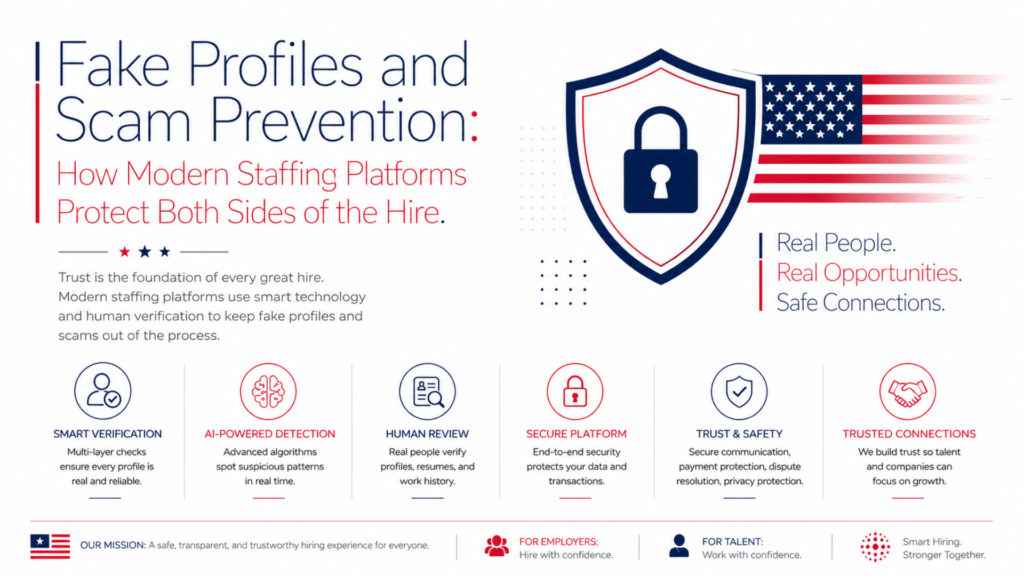
Stopping fake profiles at scale is not a single tool, it is a layered system. Here is how modern staffing platforms typically structure that defense.
Phone/email OTP verification, government ID checks for final-stage candidates, and domain verification for any company or recruiter account. This is the first and cheapest filter, and it stops the largest volume of low-effort fake profiles before they enter the pipeline.
Natural language models cross-check resume claims against employment history patterns, flag inconsistent timelines, and detect templated or AI-generated text that lacks role-specific detail. This does not replace human judgment, it prioritizes which profiles need closer human review.
Systems track signup velocity, device and IP clustering, and duplicate content across "different" profiles. A cluster of new accounts from the same device applying to the same roles is a strong signal of a scripted or fraudulent operation rather than organic applicants.
Video verification at the final round, ID-to-face matching, and unscripted, role-specific technical questioning make interview proxies far harder to sustain than a resume alone.
Direct outreach to listed references and prior employers, independent of contact information supplied by the candidate, closes the loop that resume-only screening leaves open.
Report/flag mechanisms for both candidates and hiring teams, feeding a review queue, allow patterns to surface over time rather than relying on catching every fake in a single screening pass.
Comparing Detection Signals
| Signal | Fake candidate profile | Fake recruiter / job scam |
|---|---|---|
| Contact domain | Personal email inconsistent with claimed employer history | Free email domain posing as a known company |
| Verification response | Avoids video, ID checks, or live technical questions | Avoids phone calls, pushes chat-only communication |
| Urgency | Pushes for fast offer decisions to skip reference checks | Pushes for fast personal data or payment before formal offer |
| Consistency | Resume, LinkedIn, and interview answers diverge | Job posting details differ from company's actual careers page |
Why This Matters More in 2026
Generative AI has lowered the cost of both fabricating a convincing candidate profile and impersonating a legitimate recruiter. Deepfake video and voice tools that once required technical skill are now accessible enough that interview-proxy fraud is being reported across IT and remote-first roles specifically, since remote screening removes the in-person verification step entirely. At the same time, AI text generation makes fraudulent job postings and recruiter messages more polished and harder to visually distinguish from legitimate outreach. The result is that verification cannot be a one-time gate at signup, it has to run continuously through the hiring funnel.
By the Numbers: 2026 Research Data
The scale of the problem is easier to see in the research than in any single anecdote. Independent studies from Gartner, the FTC, Checkr, Greenhouse, and interview-integrity vendors all point the same direction: fraud is growing on both sides of the hiring table, and it is growing fast.
| Finding | Figure | Source |
|---|---|---|
| Candidate profiles projected to be fake or AI-fabricated worldwide by 2028 | 1 in 4 | Gartner |
| Live interviews flagged for AI-cheating behavior (Jul 2025 to Jan 2026 sample) | 38.5% | Glozo interview-integrity analysis |
| Organizations that report having hired a fraudulent candidate | 41% | GetReal Security, via Security Magazine |
| Organizations reporting identity fraud among new hires | 23% | Checkr |
| Recruiting leaders now conducting interviews in person specifically to combat fraud | 72.4% | Gartner, via Computerworld |
| Hiring managers who caught a candidate using AI deceptively during hiring | 65% | Greenhouse 2026 AI in Hiring Report |
| Year-over-year growth in reported deepfake attempts during hiring | 1,300% | Pindrop 2025 Voice Intelligence Report |
| Reported job-scam losses in the U.S. in 2024, up from $90M in 2020 | $513M+ | FTC Consumer Sentinel Network |
| Job seekers who encountered at least one fake job posting in 2025 | 6 in 10 | PasswordManager.com survey |
| Job seekers who fell for a hiring scam outright in 2025 | 1 in 4 | PasswordManager.com survey |
Figures reflect the most recent published data as of 2026 and are drawn from multiple independent sources; treat as directional rather than a single unified count, since methodologies differ across FTC, Gartner, and vendor-run surveys.
Frequently Asked Questions
How common are fake candidate profiles in 2026?
What is an interview proxy, and how does it work?
How can a job seeker tell if a recruiter is fake?
Can AI-generated resumes be detected reliably?
Why are deepfake video interviews becoming more common?
What should employers do first to reduce candidate fraud?
Building a Layered Defense: The Core Principle
No single check catches everything. Identity verification stops low-effort fraud, AI screening prioritizes review, behavioral analysis catches coordinated schemes, and live verification closes the gaps that static documents cannot cover. The strongest staffing platforms combine automated screening with trained human judgment at the final stages, since scam tactics evolve specifically to defeat whichever single layer is weakest.
Hiring with Confidence, on Either Side
Yochana pairs verified recruiter relationships with rigorous candidate screening, so hiring managers and job seekers both know who they are really talking to.
Talk to YochanaSources: HR Dive: By 2028, 1 in 4 Candidate Profiles Will Be Fake, Gartner Predicts · BridgeView IT: Detecting Candidate Fraud in 2026 · Glozo: Deepfake Job Candidates, How Recruiters Verify Who's Real · Lloyd Staffing: Recruitment Scams Survival Guide · JobScamScore: Job Scam Statistics 2026 · Sherlock: 52 AI Interview Cheating Statistics 2026