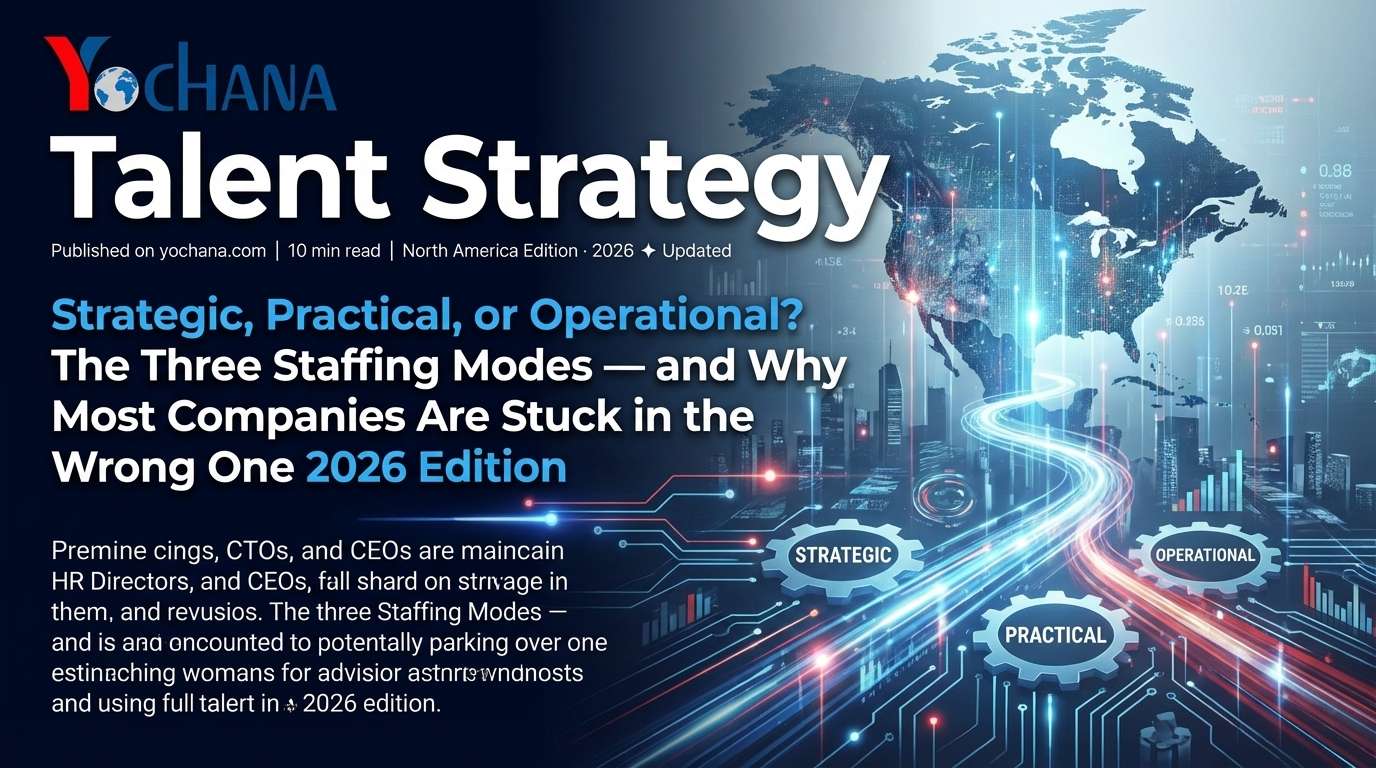

Strategic, Practical, or Operational?
The Three Staffing Modes — and Why Most Companies
Are Stuck in the Wrong One
2026 Edition
Ask any HR Director, VP of Talent, or CEO how they hire — and almost every one of them will use the word "strategic." Ask them what their average time-to-fill is, whether they have a proactive talent pipeline, and whether their staffing partner brings them curated shortlists or raw applicant volumes — and a very different picture emerges. The gap between the staffing mode companies think they operate in and the one they actually occupy is where most hiring failures quietly begin.
There are three distinct modes of talent acquisition in IT staffing. Understanding which one your organisation is operating in right now is the first step to becoming genuinely competitive for the talent you need in 2026. Most companies land somewhere they did not choose — and they stay there because nobody has named the problem clearly enough to fix it.
This article names it clearly.
The Three Staffing Modes — Which One Are You In?
These are not aspirational categories. They are operational realities — and every talent acquisition function, regardless of company size or sector, maps to one of them at any given time. The goal is not to judge where you are. It is to understand it clearly enough to move.
Hiring decisions are driven entirely by urgency. A role opens, a posting goes live, and the race begins. There is no pipeline, no proactive sourcing, and no time to be selective — because the business needed someone in that seat yesterday. Quality is sacrificed for speed, and then speed becomes the justification for poor outcomes.
There is a defined process. Job descriptions are reasonably specific. Interviews follow a consistent format. Decisions take time but are usually defensible. This is where most mid-size companies live — and it is a significant improvement over purely operational hiring. But it is not strategic. It is careful execution of a process that is still fundamentally reactive.
Hiring decisions are made before urgency arrives. Talent pipelines are active and continuously maintained. Skill gaps are projected against roadmaps, not discovered when a project stalls. The staffing partner is embedded in planning conversations, not called when a role has already been vacant for three weeks. This is where the organisations winning on talent in 2026 operate.
Quick diagnostic: When was the last time you hired for a role before it was officially open? If the answer is "we don't do that," you are operating in Mode 1 or Mode 2. Strategic organisations hire in anticipation of need — not in response to crisis.
Why Most Companies Think They're Strategic — But Aren't
The gap between perceived and actual staffing maturity is not a failure of intention. It is a failure of visibility. Leaders articulate strategic goals — workforce planning, capability building, talent pipeline investment — and then hand execution to a team that has no structural capacity to deliver on those goals because they are buried in operational volume.
The result: strategy at the whiteboard, operations on the ground. And the gap between the two is where bad hires, long vacancies, and high turnover quietly compound.
-
1Your hiring is triggered by departure, not by roadmap In a strategic organisation, headcount decisions are driven by where the business is going — new product lines, technology migrations, market expansion. In most organisations, they are driven by who just resigned. If the opening of a role consistently surprises you, your staffing function is reactive by design, regardless of what your workforce plan document says. ⚠ Signal: You are in Operational or Practical mode
-
2Your talent pipeline exists on paper but not in practice Many companies have a nominal talent pipeline — a spreadsheet of previous candidates, a folder of résumés from the last search, an ATS full of historical applicants. A real pipeline is a set of active, warm relationships with pre-qualified candidates who have been communicated with in the last 90 days and are selectively open to the right move. The difference between these two things is the difference between a 42-day search and a 7-day fill. ⚠ Signal: Your pipeline is a filing system, not a relationship network
-
3Your staffing partner is a vendor, not a partner There is a meaningful operational difference between a staffing firm you call when a role opens and a staffing firm that sits in your quarterly planning meetings. The former is a transactional vendor. The latter is an embedded talent partner who understands your technology roadmap, your team dynamics, your culture, and your 18-month hiring trajectory. The firms consistently in Mode 3 have made this transition. Most have not. ⚠ Signal: You call your staffing firm after the role has been vacant for weeks
-
4Speed and quality are treated as trade-offs — not as complementary outcomes A persistent belief in Operational and Practical mode organisations is that hiring faster means hiring worse. This is a process failure, not a market reality. With a maintained talent pipeline and a structured pre-screening system, it is entirely possible to deliver three interview-ready, skills-verified, culturally-aligned candidates within 5–7 business days. Speed and quality stop being a trade-off the moment the pipeline is built proactively. ⚠ Signal: You accept 42 days as "normal" because quality takes time
-
5Your success metric is applications, not outcomes Operational mode organisations measure hiring activity: number of applications received, number of interviews scheduled, number of job boards used. Strategic organisations measure hiring outcomes: 90-day retention rate, time-to-productivity, quality-of-hire score, cost-per-successful-placement. If your weekly recruiting update leads with volume, you are measuring the wrong thing — and optimising toward it. ⚠ Signal: Your recruiting dashboard shows inputs, not outcomes
"Most organisations are not under-investing in talent. They are investing in the wrong activities — volume sourcing, reactive searches, and process complexity that burns time and budget without building any long-term capability. The shift from operational to strategic hiring is not a budget decision. It is a model decision." — Gayathri Meduri · Sr. Talent Acquisition Manager, North America · Yochana IT Solutions · 2026
What Staying Operational Is Costing You
The cost of operating in Mode 1 or Mode 2 is not just the cost of a bad hire — though that alone averages 3× the role's annual salary. It is the compounded, often invisible cost of talent decisions made under pressure: higher attrition, lower team morale, delivery delays, and the slow erosion of institutional knowledge that happens when the wrong people are placed in critical roles.
| Dimension | Operational Mode | Practical Mode | Strategic Mode |
|---|---|---|---|
| Trigger for hiring | Departure or crisis | Role approval + posting | Roadmap + proactive planning |
| Average time-to-fill | 42–60 days | 28–42 days | 5–10 days |
| Candidate source | Job boards only | Job boards + some network | Pre-warmed pipeline + passive talent |
| Screening method | Volume filter (ATS keyword) | JD match + 1 recruiter screen | Skills assessment + cultural fit scoring |
| 90-day retention | 60–70% | 72–80% | 88–93% |
| HR team bandwidth | Consumed by sourcing | Split: sourcing + process | Freed for onboarding and culture |
| Staffing partner role | Emergency vendor | Transactional supplier | Embedded talent partner |
The compounding cost: An IT organisation operating in Operational mode on 10 annual hires — with a 65% 90-day retention rate and a 45-day average fill — is absorbing approximately $380,000–$520,000 per year in fully-loaded talent failure costs. Most of it never appears as a single line item. It hides in team overtime, delayed releases, rehiring cycles, and the productivity drag of under-qualified placements.
How to Move Up the Maturity Ladder
The transition from Operational to Strategic does not require a complete overhaul of your HR function. It requires a clear diagnosis of where your current friction lives — and targeted interventions at each stage. Most organisations can move from Mode 1 to Mode 2 within a quarter, and from Mode 2 to Mode 3 within six months, with the right partner alongside them.
From Operational → Practical: Build the process first
Standardise your job descriptions around outcomes, not requirements. Implement a two-round interview maximum with a defined decision timeline. Establish 48-hour feedback windows as a non-negotiable team commitment. Add a role-specific skills assessment before the résumé review — not after it. These four changes alone will significantly improve your hire quality within the first 60 days.
From Practical → Strategic: Build the pipeline before you need it
The defining characteristic of a strategic organisation is that when a role opens, they are not starting a search. They are activating a relationship. This requires a staffing partner who is already sourcing, assessing, and maintaining contact with pre-qualified candidates aligned to your known roadmap — before the role officially exists. This is a fundamentally different engagement model than posting-and-praying.
- Map your 12-month hiring forecast against your product and delivery roadmap. If you can't do this, the strategic conversation hasn't started yet. Start there.
- Brief your staffing partner on capability needs, not just open roles. "We will need three senior Java engineers in Q3" is a strategic brief. "We have an opening — here's the JD" is an operational one.
- Shift your success metric from applications received to quality-of-hire score. Define what a successful 90-day looks like for every role before the search begins.
- Build a talent community, not just a talent pipeline. Passive candidates who are not ready to move today are often ready in 90 days. Maintain the relationship. Your competitor isn't.
- Make your offer process a competitive advantage. Decisions within 24 hours, offers out within 48. Every extra day of delay is a day a competitor can close your candidate.
Where Yochana IT Solutions Fits Into This Picture
Yochana is not a job board relay. We are a talent partner built to operate at the strategic layer — embedded in your planning, accountable to your outcomes, and structured to move faster than the market on your behalf.
With 15+ years of IT staffing across the USA, Canada, Mexico, and India, we have built the infrastructure, the candidate network, and the operational model to support organisations wherever they are in the maturity ladder — and to help them move up it deliberately.
- Proactive talent pipeline management — we source before you have an open role
- An extensive network of pre-qualified IT professionals in active relationship across North America
- 7-day average fill time on specialist IT placements
- Skills assessments and cultural fit scoring on every shortlist — not optional extras
- Dedicated account management — one point of contact, full strategic accountability
- Quarterly talent market briefings aligned to your technology roadmap
- Trusted by leading technology organizations—including major enterprises—across North America, LATAM, and India
The Bottom Line
Most companies are not failing at talent acquisition because the market is too competitive, the talent pool is too thin, or the budget is too small. They are failing because they are using an Operational or Practical model to compete for talent in a market that rewards Strategic behaviour.
The organisations winning on talent in North America right now are not posting more jobs. They are building better pipelines, briefing partners earlier, and moving faster — because they have invested in the right model rather than scaling the wrong one.
The question is not whether to become a strategic talent organisation. It is how quickly you can get there — and whether you have the right partner to accelerate the transition.
Stop Reacting. Start Leading on Talent.
Let's map your current staffing maturity, identify where your hiring friction lives, and build a proactive talent strategy — aligned to your 2026 roadmap. No obligation. No noise. Just a strategic conversation.