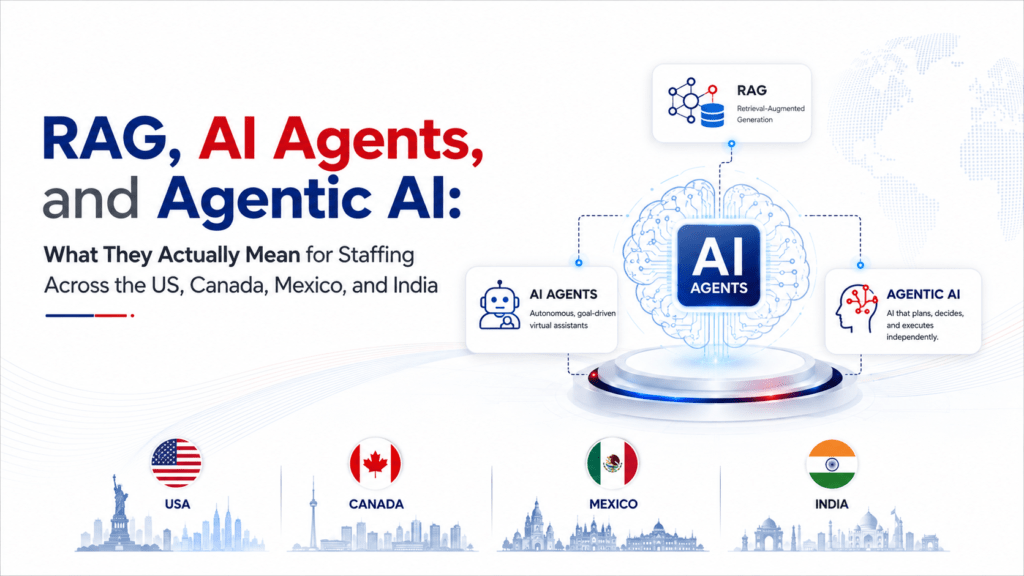
RAG, AI Agents, and Agentic AI: What They Actually Mean for Staffing Across the US, Canada, Mexico, and India
Every staffing conversation in 2026 seems to include the words "AI agent," but few break down what that means at the desk level, or what changes when a recruiting team runs candidates across four different labor markets at once. Here is a practical look at three technologies reshaping the industry, how each plays out differently in the US, Canada, Mexico, and India, and what to watch on the compliance side before rolling any of it out.
1. RAG (Retrieval-Augmented Generation)
RAG is what lets an AI system answer questions using your actual data instead of guessing from general training. In staffing, that means an AI tool can pull directly from a live ATS, a client's job requisition history, or a resume database before generating a response, rather than producing a generic answer.
- Practical use: A recruiter asks "which of our bench candidates match this Java microservices role in Austin," and the system retrieves actual resumes and skill tags instead of hallucinating a match.
- Why it matters for staffing firms: Placements live and die on accuracy. RAG grounds AI output in verifiable candidate and client records, which reduces the mismatched-submittal problem that costs agencies client trust.
2. AI Agents
An AI agent is a system that can take a multi-step action on its own, not just answer a question. Instead of a chatbot that drafts one email, an agent can source candidates, screen resumes against a job description, and schedule interviews in one continuous workflow, checking in with a human only when it hits a judgment call.
- Practical use: An agent monitors a client's open requisitions, sources from job boards and internal databases, ranks candidates, and drafts outreach, all before a recruiter's morning standup.
- Why it matters for staffing firms: Industry data shows agentic tools are already cutting sourcing time dramatically for agencies that have adopted them, freeing recruiters to spend their time on the calls and relationships that actually close deals.
3. Agentic AI
Agentic AI goes a step further than a single agent: it is a coordinated system of agents, each with its own role, working together across an entire hiring workflow, sourcing, screening, compliance checks, scheduling, and follow-up, largely without a human triggering each step. Analysts increasingly describe these systems as digital coworkers with defined permissions inside a staffing ERP, not just software features.
- Practical use: One agent handles sourcing, another validates compliance documents against a client's requirements, a third manages interview logistics, and a fourth flags anything that needs a human recruiter's judgment.
- Why it matters for staffing firms: This is the shift agencies are weighing right now, when a task-specific agent can deliver comparable throughput to a full-time coordinator role, the economics of how a staffing desk is staffed start to change.
How This Plays Out Across Four Markets
| Market | Where RAG / Agents / Agentic AI Help Most |
|---|---|
| United States | High-volume IT, healthcare, and light industrial staffing. Agentic sourcing and screening cut time-to-fill on commoditized roles, freeing recruiters to focus on high-margin, specialized placements where relationships still decide the deal. |
| Canada | Cross-border placements (e.g., the Windsor-Detroit corridor) benefit from RAG-grounded matching that accounts for province-specific credentialing and work-authorization rules, reducing back-and-forth between recruiter and client on eligibility. |
| Mexico | Nearshore IT and manufacturing talent pools are growing fast; agentic screening helps staffing teams quickly validate bilingual and technical skill claims at volume, before a human recruiter invests time in a call. |
| India | Deep technical talent pipelines mean sourcing volume is rarely the bottleneck, matching precision is. RAG-based tools that retrieve from verified skill and project history data help surface the right candidates out of a very large pool, faster. |
A Realistic Adoption Path for a Staffing Desk
Agencies that get value from this technology tend to roll it out in stages rather than switching on a fully autonomous system overnight.
- Stage 1 - Retrieval first: Connect a RAG layer to the ATS and resume database so recruiters get grounded, searchable answers instead of relying on manual keyword search.
- Stage 2 - Single-task agents: Automate one workflow at a time, sourcing, or screening, or interview scheduling, with a human reviewing agent output before it reaches a candidate or client.
- Stage 3 - Coordinated agentic workflows: Once individual agents are trusted, link them into an end-to-end pipeline, with defined checkpoints where a recruiter signs off, particularly on compliance-sensitive steps.
- Stage 4 - Human oversight built in, not bolted on: The agencies pulling ahead treat human review as a permanent part of the workflow design, not a temporary training-wheels phase.
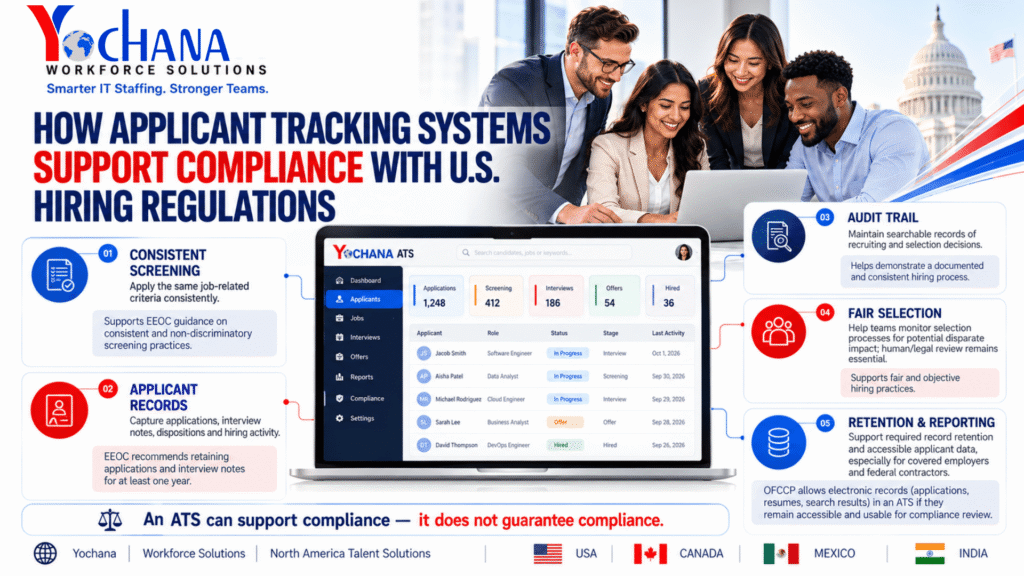
Compliance: What Changes by Market
AI hiring tools are regulated differently in each country Yochana operates in, and the staffing firm, not just the software vendor, typically carries the compliance obligation.
| Market | What Governs AI in Hiring |
|---|---|
| United States | EEOC guidance under Title VII, the ADA, and the ADEA prohibits algorithmic discrimination by race, sex, age, or disability. Employers remain liable for the tools they use, and several states now require bias audits or disclosure for automated hiring tools. |
| Canada | PIPEDA limits candidate data collection to what is strictly necessary for the hiring decision and requires explicit consent before resumes are fed into AI matching systems. |
| Mexico | Federal data protection law requires informed consent for processing personal data, and cross-border data transfers used in AI matching need documented safeguards. |
| India | The Digital Personal Data Protection (DPDP) Act sets consent and data-handling requirements for any AI system processing candidate personal data. |