
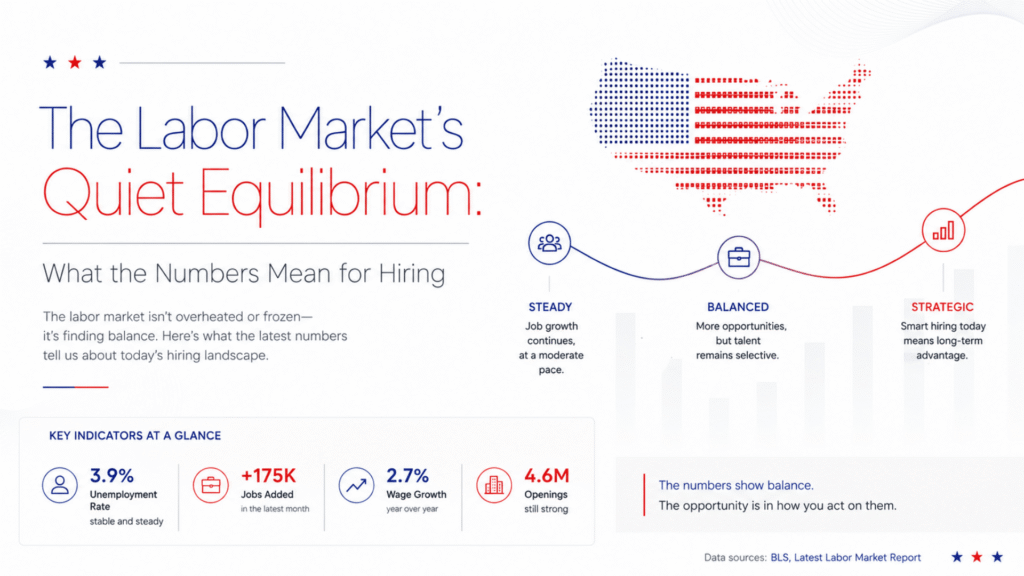
The Labor Market's Quiet Equilibrium: What the Numbers Mean for Hiring
Unemployment eased to 4.1% nationally in July, payrolls barely moved, wage growth is cooling, and Michigan is fighting a shrinking workforce even as its jobless rate ticks down. Here is a full read of the current data, what it signals for hiring managers and job seekers, and how Yochana is adjusting its own playbook in response.
In This Briefing
A Market Holding Steady, Not Sprinting
The July Employment Situation report from the Bureau of Labor Statistics showed nonfarm payrolls slipping by 23,000 while the unemployment rate ticked down a tenth of a point to 4.1%, from 4.2% in June. That combination looks contradictory at first glance, but the underlying flow data tells a calmer story: the decline reflects fewer people losing jobs, not people giving up the search. Health and social assistance, construction, and professional and business services outside of temp staffing all added jobs, while government, leisure and hospitality, and retail trade pulled back.
Labor force participation slipped to 61.4%, its lowest level since early 2021, largely because a slowdown in immigration is letting retirements outpace new entrants into the workforce. That shrinking labor force lowers the bar for what counts as healthy job growth going forward, likely somewhere between flat and 30,000 jobs a month. The broader U-6 measure of unemployment, which folds in discouraged and underemployed workers, held steady at 7.9%, suggesting the tightening is happening at the margins rather than across the board.
Weekly initial unemployment claims have stayed low through the summer, at times touching their lowest levels in decades, which points to employers still holding onto the staff they already have even as new hiring has slowed. The next Employment Situation report, covering August, is due September 4, alongside a preliminary annual benchmark revision to payroll data on August 28 that could reshape the picture further.
Unemployment Rate, 2026 (Monthly, Seasonally Adjusted)
Openings Are Plentiful, Movement Is Not
The June Job Openings and Labor Turnover Survey (JOLTS) painted a picture of a market that is open for business but cautious about switching seats. Job openings held near 7.4 million. Hires were essentially flat at 5.3 million, and total separations were unchanged at 5.4 million, with quits at 3.2 million and layoffs and discharges at 1.8 million. Low quits combined with low layoffs is the classic sign of a "low-hire, low-fire" labor market: employers are not cutting headcount, but employees are not jumping ship either.
June JOLTS Snapshot
Temp help services added 3,400 jobs in July, and the temporary agency penetration rate edged up to 1.58% from 1.57% in June. Small moves, but temp penetration is historically one of the earliest signals of a shift in hiring appetite, in either direction, since employers typically test demand with contract labor before committing to permanent headcount.
Wage Growth Is Cooling Too
Annual wage growth slowed to 3.2% in July, down from 3.4% in June. That takes some pressure off employers who have spent the last few years absorbing steep pay increases, but it also means workers have less room to outrun inflation. Real average hourly earnings actually dipped 0.1% in July, even as nominal average hourly earnings rose 0.1%, because consumer prices rose at roughly the same pace. For candidates, that combination makes total compensation and benefits more persuasive than a headline raise. For employers, it means base pay alone is no longer enough to win a close decision.
Which Sectors Are Actually Hiring
National headline numbers hide a lot of variation by industry. In July, three sectors did most of the heavy lifting on job creation, while three others accounted for nearly all of the losses.
Where jobs were added
Where jobs were lost
For staffing and technology hiring specifically, this is a reasonably favorable mix: the sectors adding jobs, professional and business services in particular, are the same ones that tend to drive demand for skilled contract and permanent technical talent.
The Michigan Picture
A Cooling but Still Tight Market
Michigan's seasonally adjusted unemployment rate dipped a tenth of a point to 4.9% in July, but the improvement came for the wrong reason: 29,000 people left the state's labor force and total employment fell by 23,000, marking a seventh straight month of employment declines that has grown larger each month since spring. Labor force participation fell 0.4 points to 59.1%, and the employment-population ratio slipped to 56.2%, both well below the national figures.
The takeaway for Michigan employers, echoed by the Michigan Chamber, is that a lower unemployment rate does not mean the worker shortage is over. It often means fewer people are in the hunt at all. For companies hiring in Michigan and the wider Windsor-Detroit corridor, that keeps competition for engaged, qualified candidates just as fierce as when unemployment was lower.
What This Means If You're Hiring
A low-hire, low-fire market rewards speed and precision over volume. Candidates who are actively looking are more likely to be strong, motivated movers rather than passive browsers, but the pool of people willing to leave a stable role is smaller than in a hotter market. That makes a tight, well-run process the difference between landing a strong hire and losing them to inertia, especially in a state like Michigan where the available labor pool itself is shrinking.
What This Means If You're Job Searching
With job openings still near 7.4 million, roles exist. The catch is that both employers and candidates are being more deliberate, so timelines can run longer and processes more thorough. Positioning matters more than volume: fewer, better-targeted applications tend to outperform mass applying in a market like this one, and total compensation now carries more weight than the base number alone.
For Hiring Managers
Openings are steady but candidates are choosier and the labor pool is thinner in Michigan specifically. Compress your timeline, sharpen your offer, and lean on a partner who already has warm relationships with the people who fit.
For Job Seekers
Quits are low because people are being selective, not because roles have disappeared. A recruiter who knows which employers are actually hiring right now, and in which sectors, is worth more than another job board.
How Yochana Is Acting in This Market
Sourcing passive, not just active, candidates
With quits at 3.2 million a month and people staying put unless a role is genuinely better, we are spending more time on direct, warm outreach to candidates who are not actively applying anywhere, rather than relying on inbound applicant volume.
Protecting our 15-20 day average fill time
In a market where a slow process loses good candidates to inertia, speed is a competitive advantage. We are keeping our submittal-to-offer timeline tight so hiring managers can move before a strong candidate re-commits to staying put.
Leading with total compensation, not just base pay
With wage growth cooling to 3.2% and real earnings essentially flat, we are coaching clients to lead conversations with the full package, benefits, flexibility, growth path, since base salary alone is no longer the deciding factor it was a few years ago.
Doubling down on the sectors actually hiring
Health and social assistance, construction, and professional and business services drove most of July's job growth. We are aligning our bench and outreach toward the technical and professional roles inside those sectors rather than spreading effort evenly across a cooling market.
Treating Michigan as its own market, not a national proxy
Michigan's 4.9% unemployment rate sits alongside a shrinking labor force and seven straight months of employment declines. For Windsor-Detroit corridor clients, we are factoring that tighter local supply into our search strategy and timelines rather than benchmarking off national averages alone.
Using contract and staff augmentation as a bridge
Rising temp penetration nationally tells us employers are testing demand before committing to permanent headcount. We are offering more contract-to-hire and staff augmentation paths so hiring managers can add capacity now and convert to permanent once budgets and workforce plans firm up.
Frequently Asked Questions
Q. Unemployment went down, so why does hiring feel slower?
Because payrolls and the unemployment rate can move in different directions when the labor force itself is shrinking. In July, 264,000 people left the workforce nationally, and Michigan lost 29,000. Fewer people counted as "in the labor force" can push the unemployment rate down even while actual hiring activity stays muted.
Q. What does "low-hire, low-fire" actually mean?
It describes a market where both hiring and layoffs are running below their historical pace. June JOLTS data showed hires, separations, quits, and layoffs all little changed month over month, which means most of the workforce is staying in place rather than churning between jobs.
Q. Is this a recession warning sign?
Not on its own. The flow data behind July's unemployment decline reflects fewer job losses, not a wave of people giving up their search, and initial jobless claims have stayed historically low through the summer. Economists describe the current state as a rough equilibrium rather than a sudden weakening.
Q. Why does temp help employment matter so much?
Temporary staffing is usually the first place employers add headcount when they are not yet confident enough to commit to a permanent hire, and the first place they cut when demand softens. A rising temp penetration rate, as seen in July, is an early, if modest, signal that hiring appetite is edging up.
Q. Is Michigan doing better or worse than the country as a whole?
Worse on most measures. Michigan's unemployment rate sits 0.8 percentage points above the national rate, its labor force participation and employment-population ratios are both lower, and the state has now recorded seven consecutive months of employment declines that have grown larger each month.
Q. What should a hiring manager do differently in a market like this?
Move fast once you find the right candidate, lead with total compensation rather than base pay alone, and consider contract-to-hire paths if budget approval is the bottleneck rather than candidate supply. Working with a recruiting partner who already has warm relationships in your sector shortens the gap between "we need this role filled" and an accepted offer.
Read the market with a partner who tracks it daily
Yochana has spent 16+ years matching talent with 100+ US clients. Whether you are building a team or planning your next move, we can tell you what these numbers mean for your specific role and market.
Talk to Yochana →Sources: US Bureau of Labor Statistics, Employment Situation news release (July 2026); US Bureau of Labor Statistics, Job Openings and Labor Turnover Survey (June 2026); US Bureau of Labor Statistics, Current Employment Statistics program; Michigan Department of Technology, Management and Budget, Michigan Center for Data and Analytics (July 2026); Michigan Chamber of Commerce labor market briefing.
Figures are seasonally adjusted national and state data and are subject to revision by BLS and the Michigan Center for Data and Analytics. This article is for informational purposes and is not economic or financial advice.