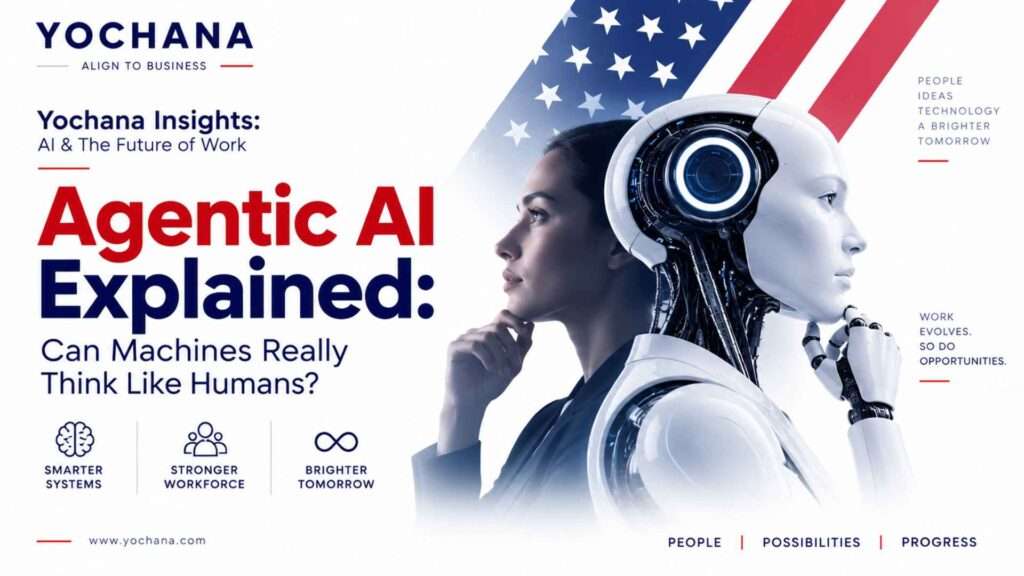


AI Cannot Take Over.
Humans Cannot Scale Alone.
The Future Belongs to the Fusion.
2026 Edition
The conversation around AI is often framed as a battle — humans on one side, technology on the other. But inside real organisations, something far more powerful is happening. Across finance, operations, HR, and talent acquisition, we’re witnessing two different forms of intelligence learning to work together. Not in competition, but in partnership. It’s not always smooth. It’s not always predictable. But it is transformative. When human judgment meets machine capability, teams unlock new levels of speed, clarity, and creativity. Workflows evolve. Roles expand. Possibilities multiply. The organisations leaning into this collaboration — embracing both human strengths and AI strengths — are already moving ahead. They’re building the future in real time. The ones waiting for a “winner” are missing the point. There is no winner. There is only progress — and it happens when both work together. The future isn’t human or AI. The future is what we create when both show up at their best.
After managing finance and operations inside a staffing firm that runs AI-assisted workflows alongside experienced human teams every day, I have a reasonably clear view of what this fusion actually looks like in practice — and where the limits of both sides sit.
This is that view.
What AI Does Exceptionally Well — and Where It Stops
The conversation about AI capabilities is consistently distorted in both directions. Enthusiasts overstate what AI can do today. Sceptics understate it. The practical reality, from inside an organisation that uses AI tools daily across finance, operations, and talent functions, is more specific and more instructive than either camp admits.
- Processes thousands of data points in seconds without fatigue or bias drift
- Identifies patterns across large datasets that no human team could surface manually
- Executes repeatable workflows with consistency — same quality at 2am as at 9am
- Flags anomalies, risks, and outliers faster than any manual review process
- Drafts, summarises, formats, and structures content at volume with no throughput ceiling
- Maintains audit trails and documentation with zero effort and zero variance
- Reads tone, subtext, and unspoken context in conversations and relationships
- Exercises ethical judgment in ambiguous, novel, or high-stakes situations
- Builds trust, rapport, and long-term relationships — with clients, candidates, partners
- Makes nuanced decisions where the right answer depends on context AI cannot fully model
- Takes accountability for outcomes and absorbs consequences of decisions
- Adapts creatively to situations that fall outside any training data or precedent
Why 100% AI Always Fails at the Moment It Matters Most
The most visible AI failures are not technical. They are judgment failures — moments where an automated system, operating without meaningful human oversight, made a decision that was technically consistent with its training data and operationally catastrophic in context.
-
1AI optimises for the metric it was given — not the outcome you actually need An AI screening tool optimised for keyword match will surface technically-aligned candidates and systematically miss the high-potential career-changer whose profile reads differently. An AI financial model optimised for cost reduction will flag the training programme that reduces attrition. The tool is doing exactly what it was designed to do. The problem is always the gap between the metric and the intent — and only a human understands the difference. ⚠ Failure mode: Optimised processes producing the wrong outcomes at scale
-
2AI has no skin in the game — and no accountability for the consequences When an AI-generated recommendation leads to a bad hire, a failed audit, or a client relationship breakdown, the system does not absorb the consequence. The human does. Accountability is not a feature that can be added to a model. It requires a person who had the authority to override, chose not to, and now owns the outcome. Full automation eliminates the feedback loop that makes organisations learn from failure. ⚠ Failure mode: Distributed responsibility with no identifiable decision-maker
-
3Novel situations will always exceed the training data AI performs exceptionally on situations it has seen before, in formats it was trained on, within parameters its designers anticipated. Every organisation regularly faces situations that fall outside all three. A global supply chain disruption. An unexpected regulatory shift. A key client relationship in crisis. These are precisely the moments that require judgment, adaptability, and the kind of contextual reasoning that no model currently delivers reliably — and that humans navigate every day. ⚠ Failure mode: Brittle automation that fails exactly when resilience is most needed
Why Humans Alone Cannot Compete in 2026
The counter-argument — that experienced, skilled humans need no AI augmentation — is equally incomplete. The operational demands on every function in 2026 have outpaced what any human team, however talented, can meet at scale without technological leverage.
-
1Volume has exceeded human bandwidth across every function A recruiter reviewing 200 applications for a single role in a seven-day fill window is not doing 200 thorough evaluations. They are pattern-matching at speed — which is exactly what AI does, but without the fatigue, inconsistency, and unconscious bias that human pattern-matching introduces under time pressure. AI does not replace the recruiter's judgment. It handles the volume so the recruiter's judgment can be applied where it actually matters. ⚠ Reality: Human-only processes are making high-stakes decisions under operational overload
-
2Data-informed decisions require data processing that humans cannot match Finance and operations teams are generating more data than any human team can meaningfully analyse in real time. Workforce cost variance, billing cycle anomalies, candidate quality trends, client engagement patterns — the signal is in the data. But turning that signal into an actionable decision within a useful time window requires AI processing as the first layer. Without it, teams are making gut-feel decisions on data they never had time to read properly. ⚠ Reality: Unprocessed data is the same as no data when decisions have a deadline
-
3Consistency at scale is a machine problem, not a people problem A human team delivering a consistent process across 500 client touchpoints, 200 active placements, and a 12-month billing cycle is not a realistic operational expectation — not because the people are not good enough, but because consistency at that scale is inherently a systems problem. AI handles the consistency. Humans handle the exceptions, the escalations, and the relationships where consistency alone is not sufficient. ⚠ Reality: Inconsistency at scale is a structural problem that human effort alone cannot solve
"The question is never AI or humans. It is always: which decisions belong to the machine, which belong to the person, and who designed the handoff between them? That design is the competitive advantage — and most organisations have not built it intentionally yet." — Radha Vairavan · Manager, Finance & Operations · Yochana IT Solutions Inc. · Novi, Michigan · 2026
What the Fusion Model Actually Looks Like in Practice
Fusion is not a technology purchase. It is an operating model decision — a deliberate choice about where AI handles the volume, speed, and consistency layer, and where human judgment takes over for context, relationship, and accountability. From inside a staffing and operations function that runs this model daily, these are the practical principles that make it work.
| Function | AI Handles | Human Handles |
|---|---|---|
| Talent Acquisition | Profile screening, keyword matching, initial pipeline ranking, interview scheduling | Final candidate evaluation, offer negotiation, relationship management, cultural judgment |
| Finance & Billing | Invoice generation, anomaly detection, variance flagging, reconciliation at volume | Exception resolution, client dispute management, strategic financial decisions |
| Operations & Compliance | Credential expiry tracking, exclusion list monitoring, documentation formatting, audit trails | Regulatory interpretation, escalation judgment, client compliance conversations |
| Client Relations | Engagement pattern analysis, response drafting, reporting, satisfaction scoring | Relationship building, trust repair, strategic account conversations, complex negotiations |
| Content & Communications | First drafts, formatting, SEO optimisation, volume content production | Strategic positioning, brand voice, editorial judgment, stakeholder communication |
The design principle behind every row in that table: AI handles the work that does not require a person to be accountable for the outcome. Humans handle everything where the consequence of being wrong requires someone to own it. That is not a technology question. It is an organisational design question — and most organisations have not answered it explicitly yet.
How to Build the Fusion in Your Organisation
The organisations that are ahead on this are not necessarily the ones with the largest AI budgets. They are the ones that made deliberate decisions about where the handoff sits — and built the workflows, the oversight structures, and the training programmes to support it. Here is where to start.
Audit your current workflows for the AI-human handoff point
For every repeatable workflow in your operations, ask: at what point does this decision require human judgment, accountability, or relationship context? Everything before that point is a candidate for AI automation. Everything at and after it requires a person. Most organisations have never mapped this explicitly — and as a result, their people are doing AI-appropriate work, and their AI is being asked to make human-appropriate decisions.
Invest in human judgment where AI is weakest
As AI absorbs more of the volume and consistency work, the premium on human judgment increases, not decreases. The people who will be most valuable in a fusion model are not the ones who can do what AI does better — they are the ones who can do what AI cannot do at all: exercise contextual judgment, build trust, manage ambiguity, and take accountability for outcomes. That capability requires investment, not reduction.
- Start with one workflow — not a transformation programme. Pick the highest-volume, most repetitive process in your team. Identify the human judgment point. Automate everything before it. Run the model for 90 days before expanding.
- Build a feedback loop from the human layer back to the AI layer. The humans reviewing AI outputs should have a structured way to flag errors, edge cases, and missed signals. That feedback is how the model improves. Without it, you are running a static tool on a dynamic problem.
- Define accountability explicitly before deployment — not after an incident. For every AI-assisted decision, identify who is accountable for the outcome. If the answer is unclear, the model is not ready to deploy without additional human oversight in the loop.
- Measure fusion performance, not AI performance in isolation. The right metric is not how much the AI tool can do on its own. It is how much faster, better, and more consistently the human-AI team performs vs. the human team alone. That is the benchmark that matters.
- Build AI literacy in your human team — not just AI tooling. People who understand what AI can and cannot do are better positioned to use it well, catch its errors, and make the judgment calls it cannot. AI literacy is now a core operational competency — not a technical specialism.
What This Means for Talent and Staffing Specifically
At Yochana, the fusion model is not a future aspiration. It is how our finance, operations, and talent teams operate right now. AI handles the volume, the consistency, and the documentation. Our people handle the judgment, the relationships, and the accountability. And the candidate and client experience — which is ultimately what determines whether a placement succeeds or fails — is entirely a human outcome, supported by AI infrastructure.
The organisations we work with that are winning on talent in 2026 are running the same model. They are not asking: can AI do this for us? They are asking: which part of this should AI do, and which part requires our best people? That is the right question. And it is available to any organisation willing to answer it deliberately.
- AI-assisted candidate pipeline management — human-led final selection and relationship management
- Automated credential tracking and compliance monitoring — human judgment on edge cases and exceptions
- AI-generated reporting and analytics — human interpretation and strategic decision-making
- Automated billing reconciliation and anomaly detection — human resolution of disputes and client conversations
- AI-supported content and communications drafting — human editorial judgment and brand voice
- Structured human oversight of every AI-assisted output that carries accountability consequences
The Bottom Line
AI cannot take over 100%. The moments that matter most in any organisation — the judgment calls, the relationship decisions, the ethical choices, the accountability moments — require a human being. That is not going to change in 2026. It is not going to change in 2030.
Humans cannot operate at 100% alone. The volume, the consistency demands, and the data processing requirements of a modern operation have exceeded what any human team can meet without technological leverage. That has already changed. It is not reversing.
The future belongs to the organisations that stop choosing between the two — and start engineering the fusion deliberately, one workflow at a time.
Build a Workforce That Fuses Both.
We help organisations build talent operations where AI handles the volume and people handle the judgment. Faster fills. Better hires. Scalable delivery. Let’s map what that looks like for your team.